
BUSINESS
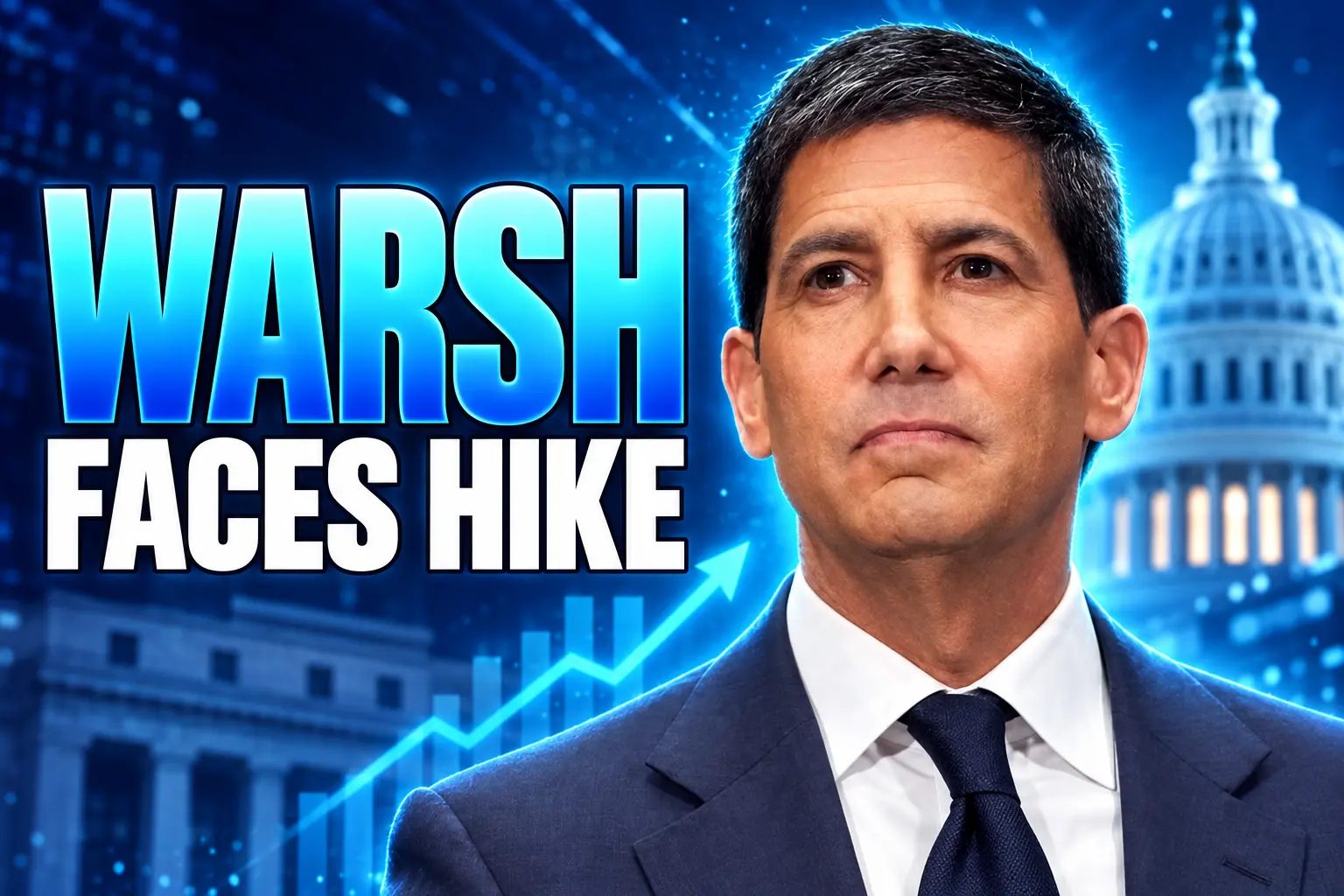
Warsh Faces a Rate Hike Trump Did Not Want
Kevin Warsh enters the Fed meeting with 85 percent hike odds, $100 oil, and a White House still demanding cheaper credit.

Interest-rate futures put an 85 percent chance on a Federal Reserve hike when Kevin Warsh’s committee votes on Wednesday. President Donald Trump picked Warsh to cheapen credit, and has demanded the lowest rates in the world.
August consumer prices were still 3.4 percent higher than a year earlier after Brent crude settled at $101.21 a barrel on September 9. The European Central Bank has already tightened. London is still expected to sit still. Tokyo is being told to move.
Warsh Goes Into Wednesday Boxed Into a Hike
Warsh was sworn in at the White House in May, after the Senate confirmed him on May 13, 2026, and Trump told him to be “totally independent.” “Just do your own thing,” the president said that day. The first two meetings under the new chair left the federal funds target at 3.50% to 3.75%.
The third meeting is the one that collides with the job description. Trump has spent the month telling the Fed to deliver the “LOWEST RATE of any country in the World,” and on Sunday, asked whether he expected an increase, he said, “I don’t know.” National Economic Council Director Kevin Hassett said on Friday that if the Fed raised rates, “The president will have something to say about it.”
Warsh has already told colleagues that if they lack confidence inflation is moving toward the 2 percent target, they have “work to do.” Futures markets treated Friday’s consumer-price report as the trigger. TD Bank and JPMorgan Chase changed their calls toward a hike after the print. A hold would now be the surprise, and Warsh has spent the summer arguing that surprises are exactly what he does not want to feed.
They really are in a no-win situation where they incur the president’s wrath or diminish their credibility in the markets, with consequences for inflation that are probably more severe down the road.
Maurice Obstfeld, senior fellow, Peterson Institute for International Economics
Trump saw the plot in January, while he was still interviewing candidates. “They’re saying everything I want to hear, and then they get the job,” he said. “They get the job, and all of a sudden, ‘Let’s raise rates a little bit.’”
Gasoline Alone Did a Third of August’s Jump
The Bureau of Labor Statistics said the all-items index rose 0.4 percent in August after 0.1 percent in July, leaving the 12-month rate at 3.4 percent, the same as July. Gasoline rose 3.9 percent in August and accounted for more than a third of that monthly increase. Energy was up 16.3 percent over the year. Gasoline was up 27.4 percent.
Brent’s $101.21 close on September 9 was the first settlement above $100 since July, after US strikes on Iranian tankers and Houthi attacks that again threatened Saudi supply. The Strait of Hormuz, fully closed, would cut about 20 percent of global oil. Pump prices averaged $4.30 a gallon on Friday. Diesel moved past $6 a gallon.
THE AUGUST PRICE SHEET
- Headline CPI: Up 3.4 percent from a year earlier, unchanged from July, with the index at 334.980.
- Core prices: Up 2.4 percent over the year, down from 2.5 percent, and up 0.3 percent on the month.
- Shelter: Up 0.3 percent in August and 3.0 percent over the year, a slower grind than energy but still above target.
- Airfare: Up 2.7 percent in August and 23.4 percent from a year earlier, another travel cost tied to fuel.
The fuel oil index up 52 percent over the year is the sharpest line in the energy complex, and it is the channel that turns a tanker war into a heating bill. Food was quieter, up 0.1 percent on the month and 2.7 percent on the year, which is why the political argument keeps landing on the pump rather than the grocery aisle.
Why a Hold Could Cost More Than a Hike
Warsh has cut back the forward guidance that used to tell markets what came next, then talked enough about the 2 percent target that a pause now has to be explained. The 30-year Treasury yield jumped on July 29 when the Fed held and the chair did not satisfy investors that inflation was in hand. Long rates are what set mortgages. A short-rate hold that sends long rates up is the version of easing that does not ease.
Hassett tried to put an election frame around that choice. On Sunday he said he would be wary of a rate hike, arguing the Fed has raised rates ahead of an election only a couple of times back to 1913, and that an independent Fed “stay[s] out of the way of elections.” He also said Trump “will defend the independence of Kevin Warsh above all.” Those two sentences do not sit easily together.
THE VISE AROUND THE CHAIR
- The White House: Trump wants cheaper money before November’s midterms, and Hassett has now said a hike would not make the president “super happy.”
- The committee: Three voters already dissented for a hike in July, and a hold after Friday’s report would undercut Warsh with the people he has to lead.
- The market: Futures imply an 85 percent chance of a quarter-point increase, so a pause would be read as a political choice unless the statement can show otherwise.
Heather Long, chief economist at Navy Federal Credit Union, put the same bind in plainer words: if he hikes he gets a social post, and if he holds he gets the market. Patrick Harker, the former Philadelphia Fed president now at Wharton, argued the other way, that a hike can actually help the administration if it calms inflation fears that have been lifting long-term yields.
July’s Three Dissents Already Broke the Pause
The June meeting, Warsh’s first as chair, was unanimous. The July meeting was not. Beth Hammack of the Cleveland Fed, Neel Kashkari of Minneapolis and Lorie Logan of Dallas voted for a quarter-point increase and lost 9-3. That is the live split he takes into Wednesday, not a theoretical one.
WARSH’S FIRST FOUR MONTHS
- May 13, 2026: The Senate confirms Warsh. He takes the chair from Jerome Powell, who stays on as a governor.
- June 17, 2026: The FOMC votes 12-0 to hold at 3.50% to 3.75%. Nine of 18 officials pencil in at least one hike this year. Warsh files no dot of his own.
- July 29-30, 2026: The committee holds again, this time 9-3. Hammack, Kashkari and Logan dissent for a hike. Bond yields jump after the press conference.
- Late August 2026: At Jackson Hole, Warsh says the Fed has “work to do” unless inflation is moving toward 2 percent with enough speed.
- September 11, 2026: The BLS holds headline inflation at 3.4 percent. Futures lift hike odds to 85 percent for the September 15-16 meeting.
Powell’s decision to remain as a governor blocked a second White House seat on the board. Trump has also tried to fire Governor Lisa Cook, a bid so far stopped in court, and the Justice Department ran a criminal inquiry into Powell over the Fed’s building project that a judge later called an abuse of power. The people around the table have reasons, beyond the oil price, to treat independence as something they have to demonstrate.
London Holds Its Nerve as Tokyo Is Pushed to Move
The Bank of England has kept Bank Rate at 3.75 percent since the Iran war began at the end of February. In July the Monetary Policy Committee voted 6-3 to hold, with chief economist Huw Pill, Megan Greene and Catherine Mann wanting 4 percent. That was one more hike vote than June’s 7-2 split. Governor Andrew Bailey has kept saying market pricing is a risk premium on the war, not a signal that Threadneedle Street is edging toward a rise, and he told a July press conference not to leave the room thinking the Bank was heading that way.
UK output still grew 0.4 percent in the second quarter, and July consumer prices were 2.9 percent. Bailey has argued that higher mortgage rates have already done some of a hike’s work. Thomas Pugh, chief economist at the consultancy RSM, said the latest energy jump had “materially increased the chance that the MPC will eventually follow other major central banks and raise rates,” while still expecting a hold on September 17 with minutes that leave the door open. Markets have been betting on four UK rises over the next 12 months since oil went back through $100.
The Bank of Japan is on a different clock. It lifted its policy rate to 1.00 percent in June, the highest in more than 30 years, held in July, and is widely expected to go to 1.25 percent at the September 17-18 meeting. Governor Kazuo Ueda has said the board will weigh crude, AI demand and the yen. US Treasury Secretary Scott Bessent has been much less shy about the destination.
THE FOUR BIG RATE DECISIONS
| Central bank | Policy rate | Last decision | Next date | Base case |
|---|---|---|---|---|
| Federal Reserve | 3.50% to 3.75% | Hold in July, 9-3 | September 16 | Hike, 85 percent odds |
| Bank of England | 3.75% | Hold in July, 6-3 | September 17 | Hold, hawkish minutes |
| Bank of Japan | 1.00% | Hike to 1.00% in June | September 18 | Hike to 1.25% |
| European Central Bank | 2.50% deposit | Hike 25 bp on September 10 | Done | Already raised |
The ECB did not wait. On September 10 in Berlin the Governing Council voted to raise the three key ECB rates by 25 basis points, taking the deposit rate to 2.50 percent. Euro-area inflation was 3.3 percent in August, up from 2.9 percent in July, with energy inflation at 14.3 percent. Staff see headline inflation averaging 3.0 percent in 2026, 2.5 percent in 2027 and 2.1 percent in 2028, and growth of 0.9 percent this year. Unemployment was 6.4 percent in July. Lagarde called the move a “no-brainer” in the press conference that followed.
The conflict in the Middle East continues to generate inflation pressures, and inflation is set to remain well above target for an extended period.
Christine Lagarde, President, European Central Bank, Berlin press conference, September 10, 2026
Bessent Told Yen Traders He Is the House
The US and Japan bought yen together on July 31, the first American intervention in support of the Japanese currency since 1998. Japan then reported it had spent $96.4 billion supporting the yen between July 30 and August 26. The point of the rescue, as Bessent has described it, is to stop a disorderly yen from forcing Japanese institutions to dump Treasuries and driving US long rates higher.
That is why Washington is talking out of both sides of its rate book. The White House wants Warsh to ease. The Treasury wants Ueda to tighten, so the yen can rise on a rate gap rather than on another round of intervention. On September 8 at Southern Methodist University in Texas, Bessent made the wager public.
When we intervene with the Japanese yen, I have pretty good insight into what the Bank of Japan is going to do, what Japanese policymakers are going to do. I have asymmetric information. I am the house now. You can bet against me if you want.
Scott Bessent, US Treasury Secretary, Southern Methodist University, September 8, 2026
A Fed hike on Wednesday would widen the US-Japan gap again unless Tokyo follows on Friday. That is the hinge Bessent is trying to pre-commit. It is also why a Warsh increase and a Ueda increase can arrive in the same week and still serve different White House aims: one is about the midterms and the price of money at home, the other is about keeping Japanese demand in the Treasury market.
A Quarter Point Would Not Reopen Hormuz
Dallas Fed researchers Lutz Kilian, Michael Plante, Alexander Richter and Xiaoqing Zhou modelled a 15 percent global oil shortfall, allowing for some cargoes to leave the Gulf by other ports, and found a one-quarter Hormuz closure would add a 0.6 point lift to headline inflation on a fourth-quarter-over-fourth-quarter basis, and 0.2 points to core. Stretch the closure to three quarters and the hits become 1.1 points and 0.3 points, with WTI peaking at $115. Those are supply numbers. A 25-basis-point move in the funds rate does not put tankers back through the strait.
That is the limit of Wednesday’s choice, and it is the part the political fight keeps skipping. Hassett’s election warning treats a hike as a vote problem. The vote problem in the CPI is gasoline, airfares and diesel, and those prices will stay high until the waterway is ordinary again. Warsh can spend credibility on a hold, or spend political capital on an increase. He cannot spend a quarter point into a reopened strait.
The yen trade Bessent advertised in Texas gets its verdict on Friday, when the Bank of Japan announces whether it will lift its policy rate to 1.25 percent.
Disclaimer: This article is news reporting and analysis of central-bank decisions, inflation data and market pricing, and it is for information only. It is not investment, trading, tax or financial advice, and it does not recommend buying, selling or holding any security, currency, bond or derivative, or taking any position on interest rates. Readers who are considering loans, mortgages, deposits or market positions should consult a licensed financial adviser or planner who can judge their own circumstances. Figures, odds and policy rates reflect the official releases and market prices cited here as of the dates given in the piece and will change with the Wednesday, Thursday and Friday decisions and with later data.

A 2018 Sabotage Law Now Bars Claude From the Pentagon

The Iran War’s $33.4 Billion Bill Leaves Empty Missile Racks

XRP Faces the CLARITY Vote Inside a Resistance Trap

Oracle Sends Same-Day Layoff Emails After a Cloud Boom

Derrick Henry Passes Allen for Third in Rushing TDs

Trend Micro’s AI Boom Cuts Its 2026 Operating Profit

GPT-6 Astra Ships as OpenAI’s Scientist Urges Caution

Apple Freezes the iOS 27 Public Beta Before the Event

US-China AI Safety Talks Rest on a No-New-Law Pact

An Oral DHB Prodrug Clears Mouse Tumors With PD-1
-
 NEWS4 weeks ago
Trend Micro’s AI Boom Cuts Its 2026 Operating Profit
-
 NEWS3 weeks ago
GPT-6 Astra Ships as OpenAI’s Scientist Urges Caution
-
 NEWS1 month ago
Apple Freezes the iOS 27 Public Beta Before the Event
-
 NEWS3 weeks ago
US-China AI Safety Talks Rest on a No-New-Law Pact
-
 NEWS4 weeks ago
An Oral DHB Prodrug Clears Mouse Tumors With PD-1
-

 NEWS4 weeks ago
Bell Wins the Southern 500 and Closes to 12 Points
-

 NEWS4 weeks ago
Hafner Bets World Models Can Skip the Robot Data War
-

 NEWS3 weeks ago
AI Notetaker Suits Leave Meeting Hosts Holding the Risk