
NEWS
Hafner Bets World Models Can Skip the Robot Data War
Danijar Hafner left DeepMind to put Dreamer world models into imported humanoids, betting imagination training can skip the robot demonstration race.

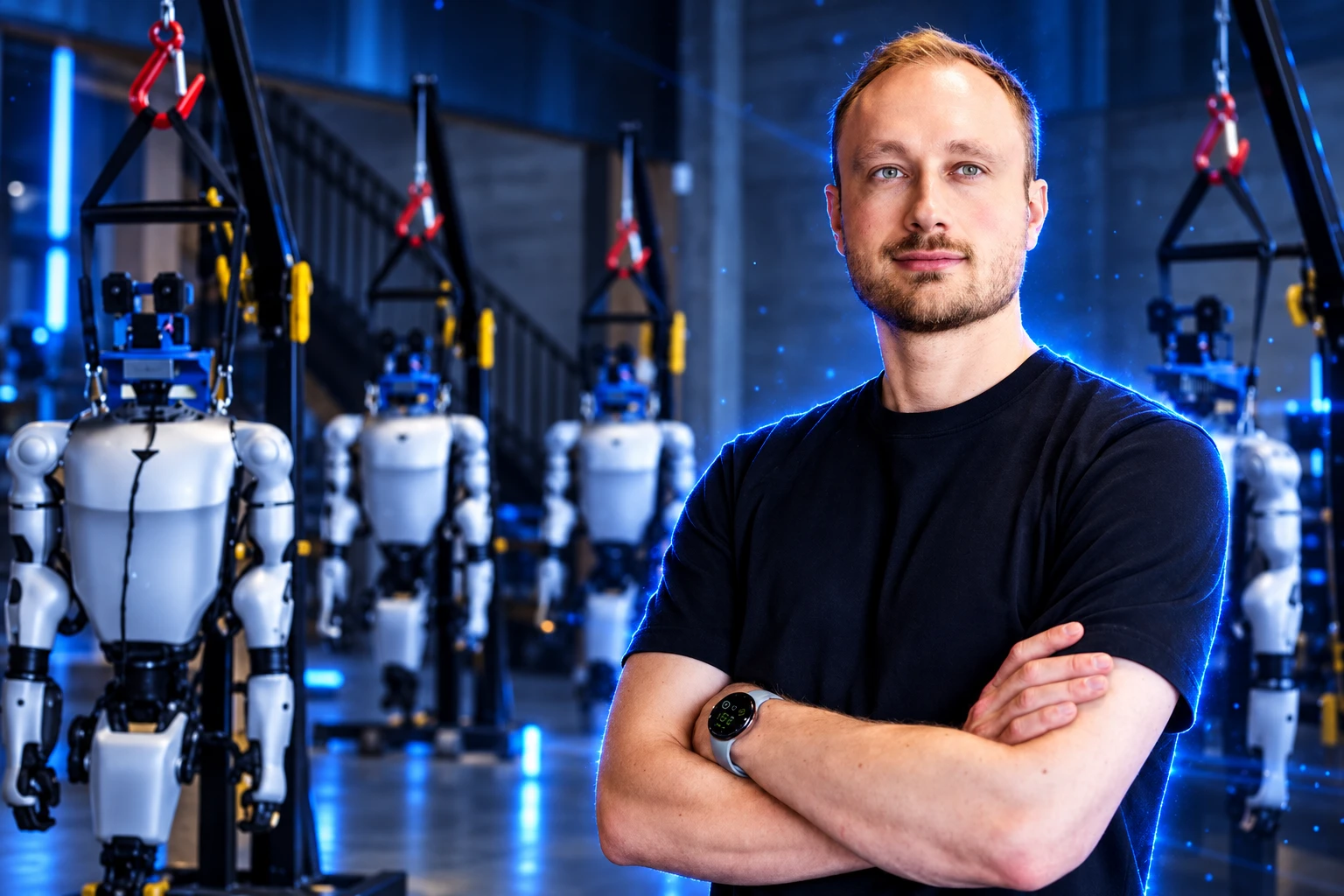
Danijar Hafner left Google DeepMind on November 3, 2025, to put world-model agents into humanoid robots that have never seen your living room. He is 31. In September 2026 his San Francisco loft in SoMa still had no name on the door, almost no furniture, and a row of imported humanoids hanging from racks like marionettes.
The wager is that those bodies do not need a warehouse of human demonstrations. They need a model that can dream the next few seconds and pick an action before anything breaks.
An Empty SoMa Loft Full of Imported Humanoids
Hafner will not say much about the company. He describes it as the next step in a long effort to let AI handle places it never saw in training. The humanoids, which he imports from China, are that idea in metal. A robot sent into a home has to cope with a floor plan and a sofa it has no map for.
He grew up in a rural town in northeastern Germany, the son of two classical musicians, and learned to code from a neighbor. Online AI courses in high school turned into an engineering degree at the Hasso Plattner Institute in Potsdam. His first Google Brain internship in Mountain View came in 2016, when, as he later recalled, nobody even had a working PPO implementation and the lab was still wrangling TensorFlow graphs. Almost 10 years followed, including 12 internships and a final 2.5 years full time, with stints in the UK, Canada, and the United States. He worked with Geoffrey Hinton in Toronto and with Ashish Vaswani, who later co-wrote the transformer paper, and he still jokes that Vaswani asked him to try the new architecture for reinforcement learning and he did not.
I get to interact with a lot of really smart people in research at Google, and he easily sits in the top half of 1%. In many cases he would build, single-handedly, things it would take entire teams of engineers to build.
Timothy Lillicrap, former manager and coauthor, Google DeepMind
Lillicrap co-wrote the later Dreamer papers with him. The loft is the first time that line of work has a door of its own, even if the door is still blank.
THE PATH FROM GAMES TO A SOMA LOFT
- 2016: Starts his first Google Brain internship in Mountain View as a student researcher.
- 2019: PlaNet shows agents can plan ahead from pixels inside a learned latent model.
- 2022: DayDreamer puts the same idea on four real robots, with no simulator in the loop.
- April 2, 2025: Dreamer 3 appears in Nature and collects Minecraft diamonds from scratch.
- September 29, 2025: Dreamer 4 is posted, mining diamonds from recorded play only.
- November 3, 2025: Last day at Google DeepMind; the SoMa company begins.
That sequence is the whole pitch. Games were never the product. They were the only place you could prove a planner without snapping a wrist joint.
How Dreamer Trains Agents Inside a Learned World
Dreamer learns a model of cause and effect from video, then practices actions inside that model rather than in the room. Dreamer 4 does this with a transformer world model that runs in real time on one GPU, so the agent can finish a Minecraft diamond run of more than 20,000 mouse and keyboard actions from recorded play without touching the live game.
Hafner calls the method model-based reinforcement learning. The world model tries to copy physical reality well enough that an agent can treat the copy as the world. It then uses those imagined rollouts to guess what happens if it moves a hand, a foot, or a mouse. Other labs still lean on real trial and error, or on copying human videos. His bet is that the copy, if it is accurate and fast, is the safer teacher.
The World Model Learns Cause and Effect
Earlier world models were fast in narrow games and bad at object contact. Controllable video models can paint pretty scenes and still fumble the physics of a tool hitting a block. Dreamer 4’s paper, Training Agents Inside of Scalable World Models, written with Wilson Yan and Lillicrap, attacks both problems with a shortcut forcing objective and a compact transformer. Shortcut models take 2 or 4 sampling steps, against 64 or more for a typical diffusion video model, which is how a person can play inside the dream on a single GPU.
Most of the knowledge can come from unlabeled video. Only a thin slice of clips needs action labels, so the model can, in Hafner’s phrasing, learn mouse and key effects in a general way and carry them into new scenes. He has said a few hundred hours of action data can be enough for that conditioning, which is the opening he wants for robots, because robot logs are slow and the internet is already full of people using their hands.
The Agent Practices in Its Own Dreams
Once the model can predict, the agent stops practicing in the real environment and starts practicing in imagination.
THREE STAGES OF IMAGINATION TRAINING
- Pretrain: A tokenizer and dynamics model learn from videos, and from actions when they exist, until the model can simulate contact and tools.
- Finetune: Task tokens are folded in so the same transformer can also emit a policy and a reward guess.
- Imagine: The policy improves on trajectories the world model generates, never on a live game step or a live robot step.
That last stage is the product claim. If the dream is faithful, a robot can rehearse a fall, a miss, or a jammed drawer without bending a finger. If the dream is wrong, the robot will look sure-footed in the loft and foolish in a kitchen.
Minecraft Diamonds Were the Dress Rehearsal
Minecraft is still the test, and not because researchers love block games. A diamond run is a long recipe with almost no reward until the end, a chain of chopping, crafting, smelting, and digging that has to hold for more than 20,000 low-level actions from raw pixels. That is closer to unloading a dishwasher in a strange apartment than it is to chasing an Atari score.
Dreamer 3, published in Nature on April 2, 2025, was the first algorithm to collect those diamonds from scratch without human data or curricula, and it did so across over 150 diverse tasks with one setup. The agents found diamonds within 100 million environment steps and climbed all 12 milestones on the way to the gem. Dreamer 2 had already reached human-level play on Atari 2600 with a world model. PlaNet, in 2019, was the first of Hafner’s planners that could act by looking ahead from pixels.
Dreamer 4, posted September 29, 2025, changes the constraint. It is the first agent to obtain diamonds in Minecraft from offline data, with no live interaction during training. Hafner’s own write-up says it beats OpenAI’s VPT offline agent while using 100 times less data than OpenAI’s VPT, and that it also beats modern behavioral cloning recipes built on pretrained models such as Gemma 3. World-model features, in that comparison, were a better base for cloning than Gemma 3’s general ones.
WHAT EACH DREAMER GENERATION PROVED
| System | When | What it showed |
|---|---|---|
| PlaNet | 2019 | Planning from pixels inside a learned model |
| Dreamer 2 | Atari era | Human-level Atari 2600 with a world model |
| DayDreamer | 2022 | Four real robots, same hyperparameters, no simulator |
| Dreamer 3 | April 2025 | Minecraft diamonds from scratch, 150+ tasks, 100 million steps |
| Dreamer 4 | September 2025 | Diamonds from offline video, 100 times less data than VPT |
He posted the Dreamer 4 videos himself the day the paper went up, including the imagined practice traces decoded back into pixels.
Excited to introduce Dreamer 4, an agent that learns to solve complex control tasks entirely inside of its scalable world model! 🌎🤖
Dreamer 4 pushes the frontier of world model accuracy, speed, and learning complex tasks from offline datasets.
co-led with @wilson1yan pic.twitter.com/iV9OCkReuq
— Danijar Hafner (@danijarh) September 30, 2025
The physical preview is older. DayDreamer, with Philipp Wu, Alejandro Escontrela, Ken Goldberg, and Pieter Abbeel, put Dreamer on four robots and let them learn online in the real world. A quadruped walked from scratch in one hour, with no resets. After people shoved it, the same stack adapted within 10 minutes, either bracing or rolling and standing up. Two arms learned pick and place from camera images and sparse rewards. A wheeled robot drove to a goal from cameras alone. The paper’s point, which the loft is now repeating at humanoid scale, is that the algorithm did not need a separate simulator of Earth.
The Data War He Is Trying to Skip
Most well-funded humanoid labs still treat behavior as something you copy. A vision-language-action model takes a camera image and a sentence and emits motor commands. Figure, Physical Intelligence, and Google’s Gemini Robotics line all sit in that family. The method is fluent on coarse motion and hungry for demonstrations of every new task, every new kitchen, every new gripper.
Yann LeCun has been the loudest critic of that hunger. He left Meta in November 2025, the same month Hafner left DeepMind, and his AMI Labs raised $1.03 billion in March 2026 at a $3.5 billion pre-money valuation to build world models instead of larger chatbots. LeCun’s claim is blunt: most human reasoning is grounded in the physical world, not in language. Hafner’s papers are the empirical cousin of that claim. He is not raising a European seed of that size in public. He is hanging robots in a nearly empty room and training them to rehearse.
NVIDIA is moving too, from the other direction. An August 4, 2026 technical post on Cosmos 3 argues that a VLM backbone learns to describe the world, not to predict how the scene will evolve. Cosmos 3 is trained on 767 million images, 348 million real-world dynamics videos, and 8 million action samples. The lab’s world-action models jointly guess future camera views and action chunks. That is a related bet with a different shape: a giant video prior, then a policy head, rather than reinforcement learning inside a compact dream.
WHERE THE ROBOT-BRAIN BETS DIVERGE
- VLA labs: Map what the robot sees and is told onto motor commands, and spend the budget on more demonstrations when a new room appears.
- World-action models: Replace the language backbone with a video model so the policy already has a physics prior, as in NVIDIA Cosmos 3.
- Hafner’s line: Train the policy by reinforcement learning entirely inside the world model, then deploy, which is what Dreamer 4 did for the offline diamond run.
The three camps can quote each other’s papers. They do not collect data the same way, and they will not fail the same way. A VLA that has never seen a particular mug can stall an inch short. A world model that hallucinates contact can commit harder, because it has already “practiced” the bad move a thousand times in a dream that was wrong.
Why Chinese Bodies Hang in a San Francisco Lab
Hafner imports the humanoids from China and hangs them down the center of the loft because the scarce piece, in his telling, is the brain. Chinese factories now sell research-grade humanoid bodies at prices a small lab can stand, and the Western software stack hangs on those frames. He has not named the makers. The visit described humanoids of various shapes and sizes, not a single flagship.
That split is the business model hiding in the decor. Figure and Tesla build the body and the brain together. Physical Intelligence sells the brain and lets other people own the metal. Hafner is closer to the second camp, with a twist: his brain is supposed to need fewer real hours on whatever body shows up, because the hours happened in imagination. DayDreamer’s same hyperparameters across a quadruped, two arms, and a wheeled base is the preview of that claim. A humanoid is a harder body, and a home is a harder room.
It is also a supply-chain choice. If the software is the product, a SoMa loft does not need a factory. It needs a rack, a GPU, and a customs invoice. The risk sits on the other side of the same choice. A planner that generalizes across bodies still has to survive the lag, the sensors, and the firmware of the particular unit that came off a Chinese line last month.
The Bet Still Has to Survive a Kitchen
Minecraft is not a kitchen. Offline diamonds are not a dishwasher. Hafner has said the offline setting matters because robots break when a half-trained agent practices on them, and that the same recipe could support household chores and factory work. He has also said the next technical steps are long-term memory so the dream stays consistent, language so the agent can take instructions, and training on general internet video so common sense is not limited to a game.
Optimizing behaviors offline is valuable for many practical applications, such as robots in the physical world, where online interaction with a partially trained agent is often unsafe.
Danijar Hafner, Wilson Yan, and Timothy Lillicrap, Training Agents Inside of Scalable World Models
The loft does not yet answer whether a dream trained on game film and a robotics dataset will open a cupboard it has never seen. Dreamer 4’s own physical test was narrower: the world model, trained on a robotics set, produced counterfactual object interactions that frontier video models still fumble. That is a physics demo, not a product.
WHAT WE KNOW
- The exit: November 3, 2025, after almost 10 years and 12 internships at Google, including DeepMind.
- The method: Imagination training inside a world model, with Dreamer 4’s offline diamond run as the strongest game result.
- The hardware: Chinese-made humanoids of mixed sizes, already in the SoMa loft in September 2026.
WHAT IS UNCONFIRMED
- The name: No public company name, and no sign on the door.
- The round: No confirmed raise, valuation, or lead investor from Hafner.
- The body: No named robot model, and no date for leaving the racks.
LeCun’s lab has the giant check and no product clock it will name. NVIDIA has the open Cosmos weights and a 16-billion-parameter policy served beside a robot arm. Hafner has the longest Dreamer paper trail, a Nature result, an offline diamond run, a quadruped that stood up in one hour, and a quiet room full of hanging bodies. He told a visitor he left because he wanted to solve a problem that would change the world. The racks are still full. The door is still blank.

Airborne DNA Identifies Burglars and People Never There

The Irkutsk Lab Death Follows an Old Plague Pattern

Data Centers Take the Trades That Housing Just Lost

The Late Pieces Steal Both WNBA Semifinal Openers

Kagi Ends Orion for Linux and Hands Off the Code

Trend Micro’s AI Boom Cuts Its 2026 Operating Profit

Apple Freezes the iOS 27 Public Beta Before the Event

US-China AI Safety Talks Rest on a No-New-Law Pact

GPT-6 Astra Ships as OpenAI’s Scientist Urges Caution

An Oral DHB Prodrug Clears Mouse Tumors With PD-1
-
 NEWS2 months ago
Trend Micro’s AI Boom Cuts Its 2026 Operating Profit
-
 NEWS2 months ago
Apple Freezes the iOS 27 Public Beta Before the Event
-
 NEWS2 months ago
US-China AI Safety Talks Rest on a No-New-Law Pact
-
 NEWS2 months ago
GPT-6 Astra Ships as OpenAI’s Scientist Urges Caution
-
 NEWS2 months ago
An Oral DHB Prodrug Clears Mouse Tumors With PD-1
-

 NEWS2 months ago
Bell Wins the Southern 500 and Closes to 12 Points
-

 NEWS2 months ago
AppLovin’s 83% Margin Guide Comes With a Compute Bill
-

 NEWS2 months ago
AI Notetaker Suits Leave Meeting Hosts Holding the Risk