
BUSINESS
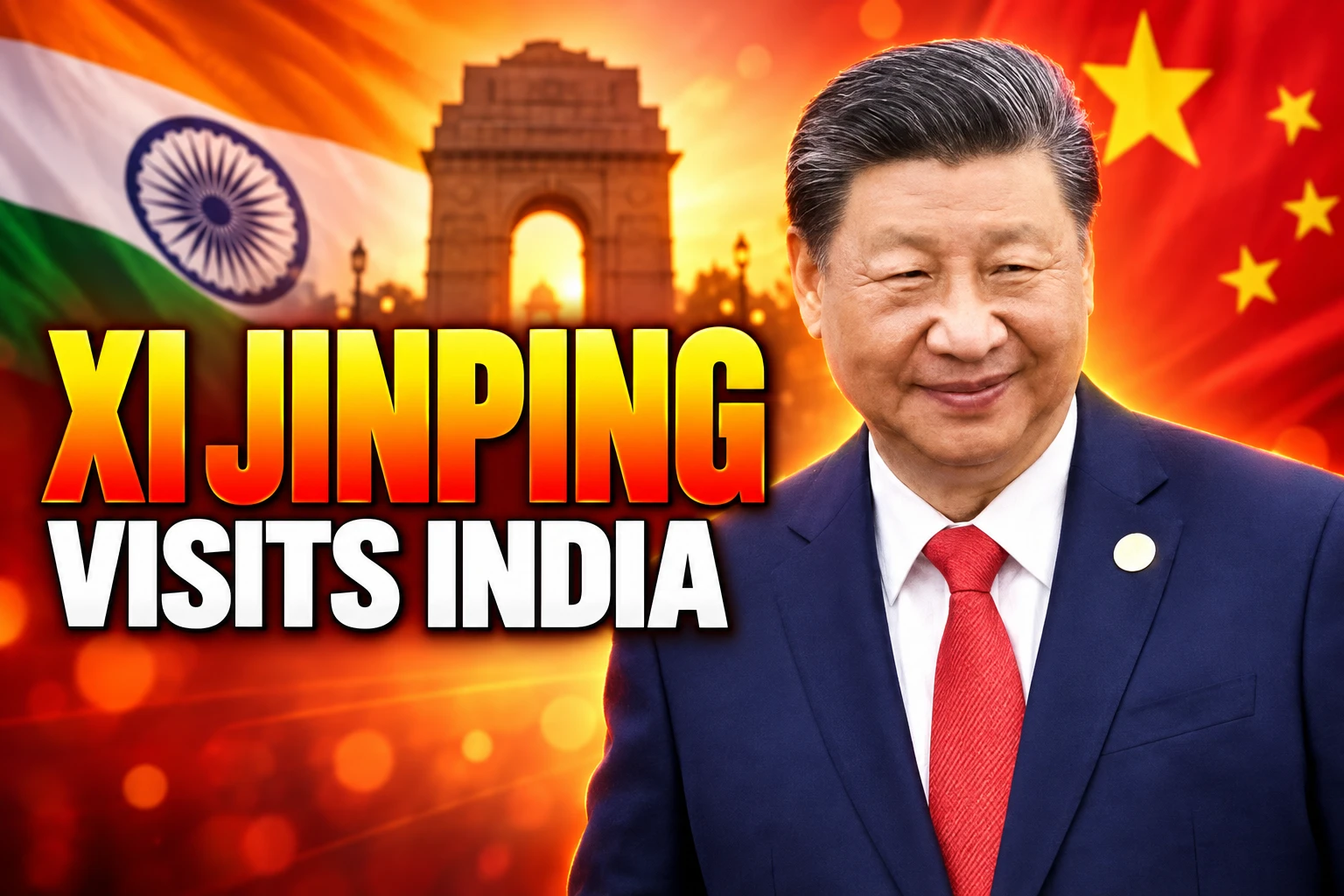
Xi Jinping Visits India as Both Sides Hedge Washington
Xi Jinping is expected in New Delhi on September 12 for BRICS, his first India visit since 2019, as both capitals hedge Washington and leave the LAC armed.

Chinese President Xi Jinping is expected in New Delhi on September 12 for the BRICS Summit, his first visit to India since 2019. A meeting with Prime Minister Narendra Modi is planned on the sidelines of the gathering at Bharat Mandapam.
Beijing has still not said in public that he is coming. The trip sits on a longer circuit that already took him through Central Asia and is due to continue toward a meeting with U.S. President Donald Trump, which is why the handshake in Delhi is being asked to do more than settle a Himalayan argument.
Xi Is Booked for Delhi Before Washington
The 18th BRICS Summit in New Delhi runs on September 12 and 13 under India’s 2026 chairship. Russian President Vladimir Putin is confirmed. Briefings in the capital on September 10 said a Chinese announcement on Xi was due the same day, with a one-on-one with Modi expected on Saturday.
Chinese Foreign Ministry spokesperson Mao Ning, asked who would represent China, said she had “no information to share” on that specific point, while repeating that Beijing supports India in hosting a successful summit. That line had not been replaced with a named-leader confirmation by the morning of September 10.
New Delhi briefings described a large Chinese party of officials and business people, on the order of 400, about twice the group that travelled in 2019. If that size holds, this is a working visit with a commercial tail, not a solo photo stop.
Xi and Modi have already met since the 2020 clash. They sat down in Kazan on October 23, 2024, after a Ladakh pullback deal, then on the sidelines of the Shanghai Cooperation Organisation gathering in Tianjin on August 31, 2025, when Modi went to China, and again around September 1, 2026, at the SCO meeting in Bishkek. What has not happened is Xi sleeping on Indian soil.
Trump received Xi in Beijing in May 2026. A Washington stop for the Chinese leader is expected after the Delhi weekend, which is why Indian officials are treating BRICS as a stage they can run without waiting on a Quad leaders’ meeting that has not been locked for 2026. Security affairs analyst C. Raja Mohan has called the wider posture “America Plus”: keep the U.S. account open, and open others because tariffs and a looser Quad calendar have made a single hedge look thin.
WHAT WE KNOW
- The dates: India will host the leaders at Bharat Mandapam in Pragati Maidan on September 12 and 13.
- The Russian guest: Putin is due in Delhi, his second trip to India since the annual summit in December 2025.
- The Indian chair: This is India’s fourth turn, after 2012, 2016 and 2021, and the grouping’s twentieth year since the 2006 foreign ministers’ meeting.
WHAT IS UNCONFIRMED
- Beijing’s readout: China has not issued a formal statement that Xi will board the aircraft.
- The clock: No official arrival or meeting time has been published for the Chinese leader.
- The deliverable: No investment or border text has been announced as a Saturday product.
The Ministry of External Affairs’ public diplomacy account posted the summit window in early September.
India will host the 18th BRICS Summit in New Delhi on 12–13 September 2026, bringing together Leaders of BRICS Member and Partner Countries, Outreach Countries, and Heads of International Organisations.
The Summit will provide a platform for dialogue, exchange of views and… pic.twitter.com/FHhLadHkyT
— Indian Diplomacy (@IndianDiplomacy) September 5, 2026
Stable, Sensitive and Still Forward-Deployed
The last deadly clash on the Line of Actual Control, in Galwan in June 2020, killed 20 Indian and four Chinese soldiers. Talks after that freeze produced a pullback in eastern Ladakh, including disengagement at Depsang and Demchok announced on October 21, 2024, the last two friction points in that sector.
Those units are no longer standing on each other’s toes. They have not gone back to peacetime camps. Buffer stretches and coordinated patrols replaced the 2020 face-offs at several sites, and Army Chief General Upendra Dwivedi said in June 2026 that the northern borders were “stable but sensitive” and that the deployment posture was being maintained.
The 3,500 km line still sets the pace for everything else New Delhi will put on a table with Beijing. External Affairs Minister S. Jaishankar has repeated that peace on the border is the condition for a normal relationship, not a side topic to be parked while trade and visas move.
On September 6 and 7, the two armies held their first corps commander-level flag meetings in the eastern sector, at Wacha on the Indian side and Damai on the Chinese side. Lt Gen Girish Kalia, commander of 3 Corps, led the Indian group after what officials described as a misunderstanding near Taksing in Upper Subansiri, Arunachal Pradesh, a stretch of about 1,140 km of LAC that 3 Corps and 4 Corps share.
MEA spokesperson Randhir Jaiswal said the two-day engagement was part of a relationship that is “gradually moving in a positive direction.” The timing, four and five days before the summit opens, is the tell. The border is being managed in real time so that a leaders’ weekend can proceed, not because the line has been fixed.
$112 Billion Travels With Every Handshake
Goods trade is the other unpaid bill. In fiscal 2025-26, China overtook the United States as India’s largest merchandise partner, and the gap in the account is the widest on record.
INDIA-CHINA GOODS TRADE, FY 2025-26
| Metric | Value | Note |
|---|---|---|
| India’s imports from China | $131.63 billion | Highest from any country |
| India’s exports to China | $19.47 billion | Up 36.66 percent |
| Merchandise deficit | $112.16 billion | Up from $99.21 billion |
| Total goods trade | $151.1 billion | Commerce Ministry data |
The deficit widened by $12.95 billion in a year even as Indian shipments to China rose, because they rose from a small base. Factories that assemble phones, solar gear and drugs still buy components, machinery and active ingredients from Chinese plants, so a manufacturing push at home has pulled more Chinese cargo through Indian ports.
Jaishankar put that imbalance in front of Chinese Foreign Minister Wang Yi in Manila on July 22, 2026, after listing the parts of the thaw he was prepared to welcome.
Fair market access and a trade balance ranks high in that regard. There are also concerns about predictability of supply chains.
S. Jaishankar, External Affairs Minister, after talks with Wang Yi in Manila
People-to-people links have moved faster than the ledger. Chinese Ambassador to India Xu Feihong wrote on September 7 that five direct flight routes have been resumed and that border trade, shut for six years, is open again. India began taking Chinese tourist visa applications on July 24, 2025. The Kailash Manasarovar yatra is back. Lipulekh and two other Himalayan trade marts have been prepared to reopen. In March, New Delhi eased screening so that Chinese firms can get automatic clearance for non-controlling stakes of up to 10 percent in some solar and electronics vehicles.
That is a partial walk-back of the 2020 investment screen, not a flood of factories. India is trying to buy capital and process knowledge without reopening the door that Press Note 3 slammed during the clash year. Beijing, for its part, has blocked some Indian farm shipments and still sells far more than it buys.
Mamallapuram Was the Last Time Xi Slept in India
Xi’s previous night on Indian soil was October 11 and 12, 2019, at the second informal summit in Mamallapuram, Tamil Nadu. Modi, in a veshti, walked him past Arjuna’s Penance, Krishna’s Butterball and the Shore Temple. They drank coconut water at Pancha Ratha. A third informal summit was supposed to follow in China. Galwan cancelled that itinerary.
The 2019 weekend had followed the Wuhan informal meeting of April 2018, itself a repair job after the 2017 Doklam standoff. Xi’s first visit to India as president, in September 2014, had opened in Ahmedabad, Modi’s home state. The pattern is familiar: a designed leaders’ setting, a claim of strategic communication, then a shock on the ridge that the setting did not prevent.
THE MODI-XI FILE, 2019 TO 2026
- October 11-12, 2019: Informal summit at Mamallapuram, Xi’s last visit to India.
- June 2020: Galwan clash kills 20 Indian and four Chinese soldiers and freezes high-level travel.
- October 21, 2024: Pullback deal at Depsang and Demchok, the last eastern Ladakh friction points.
- October 23, 2024: First formal Modi-Xi meeting in five years, on the Kazan BRICS sidelines.
- August 31, 2025: Modi meets Xi in Tianjin at the China-hosted SCO summit.
- August 25, 2026: 25th Special Representatives round in Beijing, Doval with Wang Yi.
- September 1, 2026: The two leaders meet again around the SCO summit in Bishkek.
- September 12, 2026: Xi is expected in New Delhi for BRICS, if Beijing names him.
They also brushed past each other at the Bali G20 in November 2022 and at the Johannesburg BRICS meeting in August 2023. Xi skipped the G20 that India hosted in September 2023. Those were corridor encounters. Kazan was the restart. Delhi would be the first time the restart happens in India.
What the 18th Summit Is Built to Do
India assumed the chair on January 1, 2026, with the theme “Building for Resilience, Innovation, Cooperation and Sustainability.” Modi, speaking at the 2025 Rio summit, said the goal was a people-centric forum in the spirit of “Humanity First,” the same Global South pitch India used during its G20 year.
THE DELHI WEEKEND, IN FIGURES
- Full members: 11, after Egypt, Ethiopia, Iran, Saudi Arabia and the UAE joined in January 2024 and Indonesia in January 2025.
- Partner countries: 10, among them Belarus, Kazakhstan, Malaysia, Nigeria and Vietnam.
- Chairship load: About 350 meetings already held in more than 25 Indian cities before the leaders arrive.
- Share of the world: Xu, citing international agencies, puts greater BRICS at nearly half of world population, around 30 percent of output and one-fifth of trade, with growth nearly three times the G-7’s by 2028 on an IMF path.
Saturday’s closed session for member leaders is listed at 2:35 p.m. under the title “Inclusive Global Governance and Strengthening Multilateralism,” after a 2:00 p.m. arrival at Bharat Mandapam. The rest of the day is an exhibition named Bharat Innovates, a family photograph, a tree planting and a 7:30 p.m. dinner hosted by Modi. Sunday brings partner and outreach leaders into a session on resilience, innovation, cooperation and sustainability.
Finance ministers and central bank governors were in Mumbai on September 9 and 10. The BRICS Business Forum and the Women’s Business Alliance meet around the same weekend. Other leaders listed for the hall include South Africa’s Cyril Ramaphosa, Egypt’s Abdel Fattah el-Sisi, Indonesia’s Prabowo Subianto, Iran’s Masoud Pezeshkian and Ethiopia’s Abiy Ahmed.
Hosting Iran, Russia and China in the same building, while remaining a Quad partner, is the point of the weekend for New Delhi. Washington has been watching the grouping, including through a sanctions campaign aimed at financial ties with Iran. India wants BRICS to stay a room for emerging economies, not a caucus against the United States, and it wants that on the record while Xi is in town and before Xi is in Washington.
Xu’s September 7 essay made the same geometry from the other side of the table, without naming the United States.
Certain countries have undermined the international economic and trade order by erecting tariff barriers, seeking decoupling and disrupting supply chains.
Xu Feihong, Chinese Ambassador to India, September 7, 2026
He added that India and China take the BRICS chair in succession, which puts China in the chair in 2027. A quiet, workable weekend in Delhi is in Beijing’s interest if it wants a clean handover and a calmer photo before the U.S. stop.
Doval, Wang and a Two-Day Flag Meeting
The diplomatic script for Saturday was written in Beijing on August 25, when National Security Adviser Ajit Doval and Wang Yi held the 25th round of Special Representatives talks, a channel set up in 2003. A joint eight-point consensus on the boundary followed on August 26. C. Uday Bhaskar, a retired commodore who directs the Society for Policy Studies, noted that a joint SR text is rare and that this one was agreed in 18 hours, which he read as political intent “to lock in stability ahead of a packed fortnight,” alongside “deeply embedded wariness.”
WHAT THE EIGHT POINTS LOCK IN
- Expert group: A demarcation group and a border-management working group under the existing WMCC channel, to look for an early harvest on less contested stretches.
- Hotlines: Two new military hotlines in the eastern and middle sectors, plus two new general-level meeting points, the mechanism that Wacha and Damai then used.
- LAC handling: Use current diplomatic and military channels at once when something flares, and work on a shared reading of the line in selected areas.
- Cross-border life: Three trade marts, more official pilgrimages to Kailash, and a September sitting on trans-border rivers, including hydrological data.
- Next round: The 26th Special Representatives meeting is due in India, under the 2005 pact that still calls for a package settlement of the whole border.
None of those lines moves troops off the heights. None of them trims $112.16 billion off the trade gap. They do let both governments say the border is being handled while they sit with Putin, Pezeshkian and the rest of an 11-member table that Washington cannot ignore and cannot chair.
If Xi lands on September 12, the picture will be of two leaders who have already practised the handshake in Russia, China and Kyrgyzstan, now repeating it in the host’s capital. The unpaid files will be the same ones they carried into Mamallapuram: a line that is still not a border, a ledger that still runs one way, and a third capital that both of them have to face after the gala dinner ends.

A 2018 Sabotage Law Now Bars Claude From the Pentagon

Anthropic’s Safety Pitch Already Took Fable 5 Offline

CoCounsel Legal Moves the Hard Work Onto Checking

AEM Puts AI on Farm Machines as Tractor Sales Slide

Xi Jinping Visits India as Both Sides Hedge Washington

Trend Micro’s AI Boom Cuts Its 2026 Operating Profit

An Oral DHB Prodrug Clears Mouse Tumors With PD-1

GPT-6 Astra Ships as OpenAI’s Scientist Urges Caution

Apple Freezes the iOS 27 Public Beta Before the Event

US-China AI Safety Talks Rest on a No-New-Law Pact
-
 NEWS3 weeks ago
Trend Micro’s AI Boom Cuts Its 2026 Operating Profit
-
 NEWS3 weeks ago
An Oral DHB Prodrug Clears Mouse Tumors With PD-1
-
 NEWS3 weeks ago
GPT-6 Astra Ships as OpenAI’s Scientist Urges Caution
-
 NEWS4 weeks ago
Apple Freezes the iOS 27 Public Beta Before the Event
-
 NEWS3 weeks ago
US-China AI Safety Talks Rest on a No-New-Law Pact
-

 NEWS3 weeks ago
Bell Wins the Southern 500 and Closes to 12 Points
-

 NEWS3 weeks ago
Hafner Bets World Models Can Skip the Robot Data War
-

 NEWS3 weeks ago
AI Notetaker Suits Leave Meeting Hosts Holding the Risk