
NEWS
CoCounsel Legal Moves the Hard Work Onto Checking
CoCounsel Legal’s new tables and four-stop Brief Builder shift scarce legal work onto verification, with Thomson running the 10,000-document pass.

CoCounsel Legal went on general U.S. release on August 20, 2026, with a table that can score 10,000 documents and a brief tool that pauses four times.
Thomson Reuters sells the system as an agent that works like a senior associate. The interface is plainer. Research and review finish first. Drafting comes last. Every cell and every citation is built to be checked.
CoCounsel Legal Makes Checking the Scarce Skill
Raghu Ramanathan, president of Thomson Reuters Legal Professionals, said firms are no longer shopping for a chatbot that answers a prompt. They want a path from a question to work they can file. The August 20 launch puts research, drafting, verification, and matter files in one agentic workspace, rebuilt on Anthropic’s Claude Agent SDK and grounded in Westlaw and Practical Law.
Valerie McConnell, vice president of solutions engineering, walked that workspace in a company webinar. She told attendees the companies seeing money from AI are the ones with a plan, and that firms with a clear AI strategy are nearly twice as likely to see revenue growth from the tools. That line tracks the company’s 2025 Future of Professionals survey, which put the gap at 1.9 times versus informal use.
The rebuild is not a skin on the old CoCounsel skills menu. Ramanathan said the company abandoned the old code lines after Casetext, bought in 2023 for $650 million, had already put CoCounsel on a general model. Lawyers now describe a matter in plain language. The system writes its own plan, pulls Westlaw, Practical Law, and firm files, and only then drafts.
HOW COCOUNSEL LEGAL REACHED U.S. RELEASE
- April 20, 2026: Beta opens on the rebuilt stack, with more than 100 Practical Law attorney-editors in the loop.
- Week of June 22, 2026: Every current customer gets a toggle into the next-gen chat, with the old product still running beside it.
- August 20, 2026: General availability in the United States. Canada, the United Kingdom, and Australia are due later in 2026.
- August 24, 2026: Thomson, the company’s own model, becomes the default engine for Tabular Analysis.
- October 2026: A Reveal connector is due, so reviewed evidence can move in without a fresh upload.
One million professionals across 107 countries and territories already sit on CoCounsel in some form. The new legal experience is the U.S. cut of that stack, with iManage, SharePoint, and NetDocuments live and more connectors promised through the rest of the year.
10,000 Contracts, 100 Questions, One Table
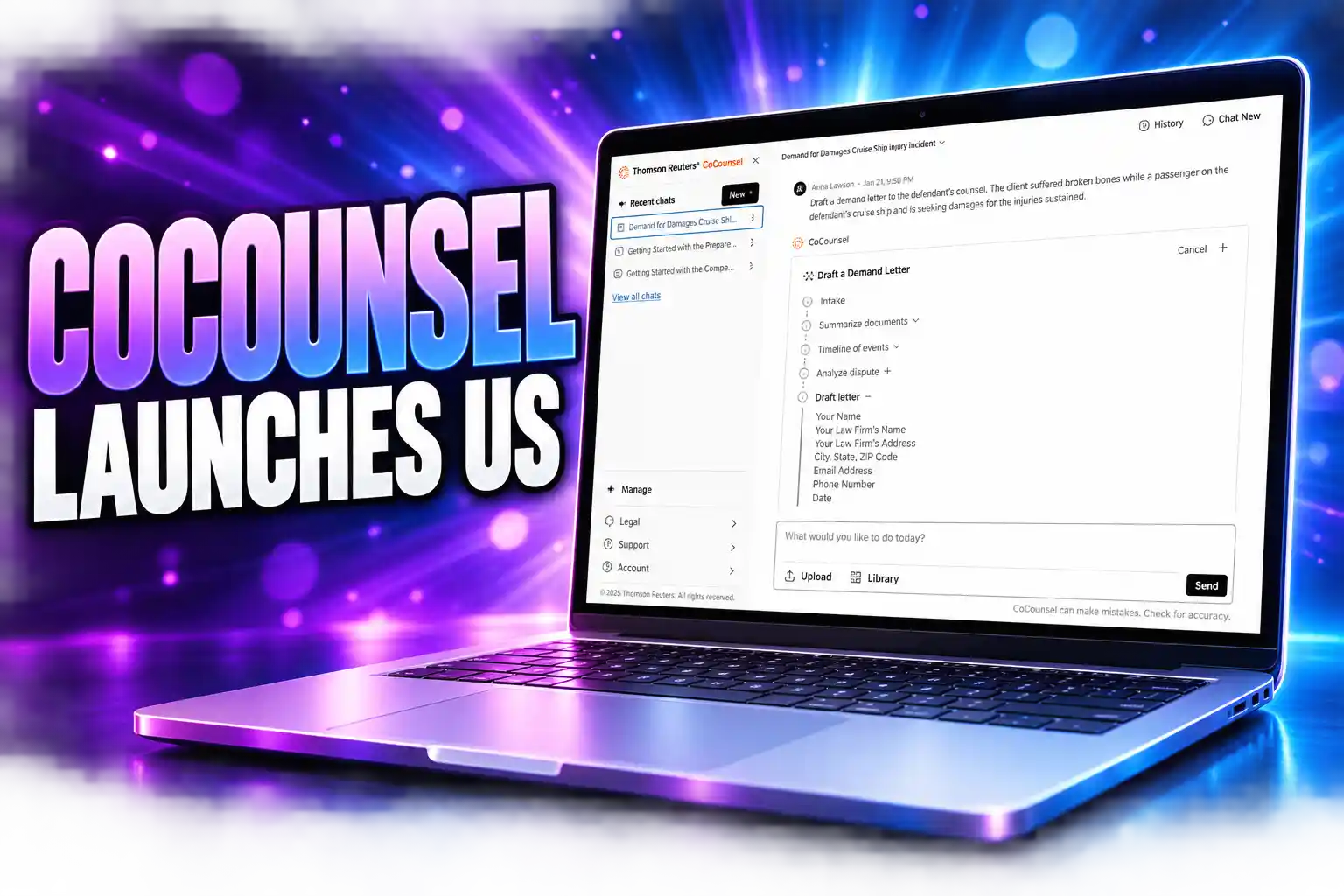
Tabular Analysis is the feature that makes the checking job visible. A lawyer can load up to 10,000 documents and ask up to 100 questions, then get one filterable table back. Each answer points at the clause it used. Ambiguous hits are flagged for a second look.
McConnell showed a change-of-control filter that pulled the riskiest contracts to the top, then turned the same table into a punch list, a client memo, and a disclosure schedule with a few more prompts. The lawyer is not reading 10,000 files in sequence. The lawyer is auditing a grid.
That is a different skill from the data-room slog juniors were hired to do. It is also the skill the product is willing to slow down for. Click the footnote or the cell does not count as done.
WHERE THE NEW TOOLS HAND WORK BACK
| Tool | Job | Where the lawyer steps in |
|---|---|---|
| Tabular Analysis | Up to 10,000 documents against 100 questions, in one table | Filter, open source footnotes, turn the grid into memos and schedules |
| Westlaw Brief Builder | First drafts of five motion types, using Westlaw, KeyCite, and Practical Law | Four review stops before a formatted brief |
| Deep Research Verify | Checks whether cited Westlaw and Practical Law authority supports the claim | The filing still goes out under the lawyer’s name |
Naming Verify as its own step is a tell. If the draft were safe to file, the pipeline would not need a productized checker sitting on top of the research agent.
Brief Builder Stops the Lawyer Four Times
Westlaw Brief Builder is the litigation half of the same idea. After a complaint and a short client story go in, the tool does not dump a finished brief. It waits.
THE FOUR STOPS IN BRIEF BUILDER
- Facts and parties: Confirm who is in the case and what the record actually says before any argument is locked.
- Proposed arguments: Accept, edit, or kill theories while they are still a list, not a formatted filing.
- Reasoning and cites: Inspect the Westlaw support under each point, including KeyCite treatment, before prose is written.
- Formatted brief: Produce the document only after those three gates have been passed.
Five motion types ship with it: motion to dismiss, motion to compel, motion for protective order, motion to exclude evidence, and motion to transfer venue. Lawyers can strip an argument out before the system writes a word of it.
A brief is only as strong as the thinking behind it. Westlaw Brief Builder was built to support that thinking, not replace it.
Emily Colbert, SVP, CoCounsel Litigation, Thomson Reuters product announcement
Jennifer Eng, a commercial litigation shareholder at Polsinelli, said the Westlaw grounding is what let her treat the draft as something she could stand on, and that the agentic path from question to draft is the first time a tool has done that for her without trading away precision. The praise is about a defensible draft, which still means a human has to defend it.
Thomson Reuters has been repeating the same four verbs in public. Research. Draft. Analyze. Verify. The last one is the product.
Research. Draft. Analyze. Verify. All in one workflow.
The next generation of CoCounsel Legal is now generally available, built on Fiduciary-Grade AI™ principles and grounded in trusted content from Westlaw and Practical Law.
Explore CoCounsel Legal here. ⬇️… pic.twitter.com/oiQ50zWlMj
— Thomson Reuters (@thomsonreuters) September 1, 2026
Why the Citations Still Need a Human
The company calls this stack Fiduciary-Grade AI, a label it uses for work where a small error can sink a case. McConnell split the market into general models, professional tools that can tolerate a miss, and this third tier, which is supposed to ground every answer in Westlaw, Practical Law, and firm precedent and show the source as it goes.
We are doing everything we can to make AI not a black box, but a system that you can use and really stake your reputation on.
Valerie McConnell, Vice President of Solutions Engineering, Thomson Reuters webinar
The reason that speech exists is the generation of tools this rebuild is trying to leave behind. Stanford researchers led by Varun Magesh, in a preregistered study later updated on August 24, 2026, found that Lexis+ AI and Thomson Reuters’s then-current Westlaw AI-Assisted Research and Ask Practical Law AI still hallucinate 17% to 33% of the time. Lexis+ AI answered 65% of their queries accurately. Westlaw’s AI-Assisted Research was accurate 42% of the time and hallucinated nearly twice as often as the other legal tools in the set.
That paper did not test the August 2026 CoCounsel Legal rebuild. It tested the prior Westlaw and Practical Law research assistants, the ones Casetext once advertised as refusing to make up facts. The gap is the point. Thomson Reuters spent 2026 tearing out the old stack, forcing drafts to wait on research, and adding a named verify pass because linked retrieval was not enough on its own.
Brooke Conkle, a partner at Troutman Pepper Locke, said the beta zeroed in on ascertainability differences between two circuits with the kind of parsing that usually eats a lot of clock. Dan Block, a director at Sterne, Kessler, Goldstein & Fox, said the new version is the first tool he opens, not a side skill. Those are real workflow shifts. They are still descriptions of a first pass that a lawyer then has to own.
Thomson Takes Over the Spreadsheet Work
Claude still plans the matter. Thomson, the company’s own model, now does the high-volume table. Thomson Reuters announced it on August 24, 2026, and said it spent $40 million training Thomson on talent and compute, starting from a strong open-source foundation and its own Westlaw, Practical Law, Checkpoint, and Reuters store. The model has seen less than 10% of that store so far.
CoCounsel Legal stays multi-model on purpose. Thomson is the default on Tabular Analysis, where a smaller specialist is cheaper to run across thousands of files. Claude’s agent kit still handles the plan-and-retrieve loop for research and briefs. A small Thomson build is going out on Hugging Face for academic, non-commercial tests. Customers do not buy the model itself.
Joel Hron, chief technology officer, has framed the bet as owning the intelligence that sits on exclusive content, then renting frontier models for the rest. Jackie Schmiedlin, an AI solutions architect, told the webinar that uploaded firm files live in that customer’s own CoCounsel instance, are not visible to other firms or to Thomson Reuters staff, are not used to train the underlying model, and come out after processing. SOC 2 and ISO 42001 are the security badges on the product page.
Tyler Alexander, director of CoCounsel AI reliability, said the rebuild started with the work, not the model card. Teams spoke with 500 legal professionals, ran 30 deep interviews, and mapped more than 40 processes across 14 practice areas before they wrote the new agent. The finding that stuck was the tab-switching: notes, PDFs, and research sitting in different windows so nobody could see the whole matter.
The Hours That Vanish Are the Junior Ones
Joe DeMedeiros, a private equity partner at Troutman Pepper Locke, said the next-gen drafts hold up when a deal is moving and the clock is short. An Am Law 200 knowledge counsel, quoted in Thomson Reuters materials, remembered junior M&A diligence as days in a data room doing by hand what the tool now does in minutes. That is the labor that gets repriced first.
A better table does not delete the partner’s signature. It deletes the hours that used to be billed for reading every contract in the pile. Firms that keep the same headcount will look slow to clients who can see a 10,000-file grid. Firms that cut the readers still need someone who can catch a bad cell before it becomes a disclosure schedule.
WHAT A FORRESTER STUDY PAID FOR BY THOMSON REUTERS FOUND
- Research and drafting: 76% of surveyed users agreed CoCounsel Legal improved quality.
- Risk: 64% agreed it helped cut errors, exposure, and compliance misses.
- Time: 33% average reduction on document review, research, and drafting.
Those figures come from a 2026 Forrester Total Economic Impact study the vendor commissioned, so they measure people already on the product, not a bake-off against Harvey or Lexis. Even on that friendly sample, the time that falls is review and first-draft time. Judgment time is what the four stops are there to protect, and it is also what clients will try to stop paying associate rates for.
Alex Fawcett, vice president of product for the CoCounsel platform, said the old and new stacks will run in parallel for a while so a lawyer can flip back if the new chat feels wrong. That toggle is a trust feature. It assumes some users will not bet a live matter on the agent until they have watched it fail safely.
ABA Formal Opinion 512 Still Governs the Output
None of this sits outside the ethics rules. On July 29, 2024, the ABA Standing Committee on Ethics and Professional Responsibility issued ABA Formal Opinion 512 on generative AI. Lawyers do not have to become model experts. They do have to understand what a given tool can and cannot do, protect client files, supervise the people and systems that touch a matter, and review outputs before a court or a client sees them.
The opinion treats generative tools as nonlawyer assistance under Model Rules 5.1 and 5.3. A four-stop brief workflow is, in that light, a supervision checklist with a nicer UI. Schmiedlin’s advice to new users was to talk to CoCounsel the way they would talk to a colleague, then use the built-in prompt enhancer if the request is messy. That is associate-management advice, not prompt-engineering advice.
Shareable workspaces are still on the near-term roadmap. Until they land, the matter context lives in one lawyer’s workspace and in the document systems already wired in. Deep Research Verify can say whether a Westlaw cite supports a sentence. It cannot take the Model Rule 3.3 candor duty off the person who files the brief.
The U.S. product is in customers’ hands. The Reveal pipe is due in October 2026, and Canada, the United Kingdom, and Australia are scheduled later in the year. The table will get faster. The pauses are the part Thomson Reuters does not appear eager to remove.
Disclaimer: This article is news reporting and analysis of a legal-technology product. It is informational only and is not legal advice, an ethics opinion, or a recommendation to use or buy any tool on a client matter. Lawyers and legal staff should consult their firm’s general counsel, ethics counsel, or a qualified professional-responsibility lawyer, and should review court standing orders, before putting generative systems on live work. Feature lists, accuracy claims, and availability windows reflect vendor materials and published studies as dated in the piece and can change.

A 2018 Sabotage Law Now Bars Claude From the Pentagon

Anthropic’s Safety Pitch Already Took Fable 5 Offline

CoCounsel Legal Moves the Hard Work Onto Checking

AEM Puts AI on Farm Machines as Tractor Sales Slide

Xi Jinping Visits India as Both Sides Hedge Washington

Trend Micro’s AI Boom Cuts Its 2026 Operating Profit

An Oral DHB Prodrug Clears Mouse Tumors With PD-1

GPT-6 Astra Ships as OpenAI’s Scientist Urges Caution

Apple Freezes the iOS 27 Public Beta Before the Event

US-China AI Safety Talks Rest on a No-New-Law Pact
-
 NEWS3 weeks ago
Trend Micro’s AI Boom Cuts Its 2026 Operating Profit
-
 NEWS3 weeks ago
An Oral DHB Prodrug Clears Mouse Tumors With PD-1
-
 NEWS3 weeks ago
GPT-6 Astra Ships as OpenAI’s Scientist Urges Caution
-
 NEWS4 weeks ago
Apple Freezes the iOS 27 Public Beta Before the Event
-
 NEWS3 weeks ago
US-China AI Safety Talks Rest on a No-New-Law Pact
-

 NEWS3 weeks ago
Bell Wins the Southern 500 and Closes to 12 Points
-

 NEWS3 weeks ago
Hafner Bets World Models Can Skip the Robot Data War
-

 NEWS3 weeks ago
AI Notetaker Suits Leave Meeting Hosts Holding the Risk